
Negative Creep

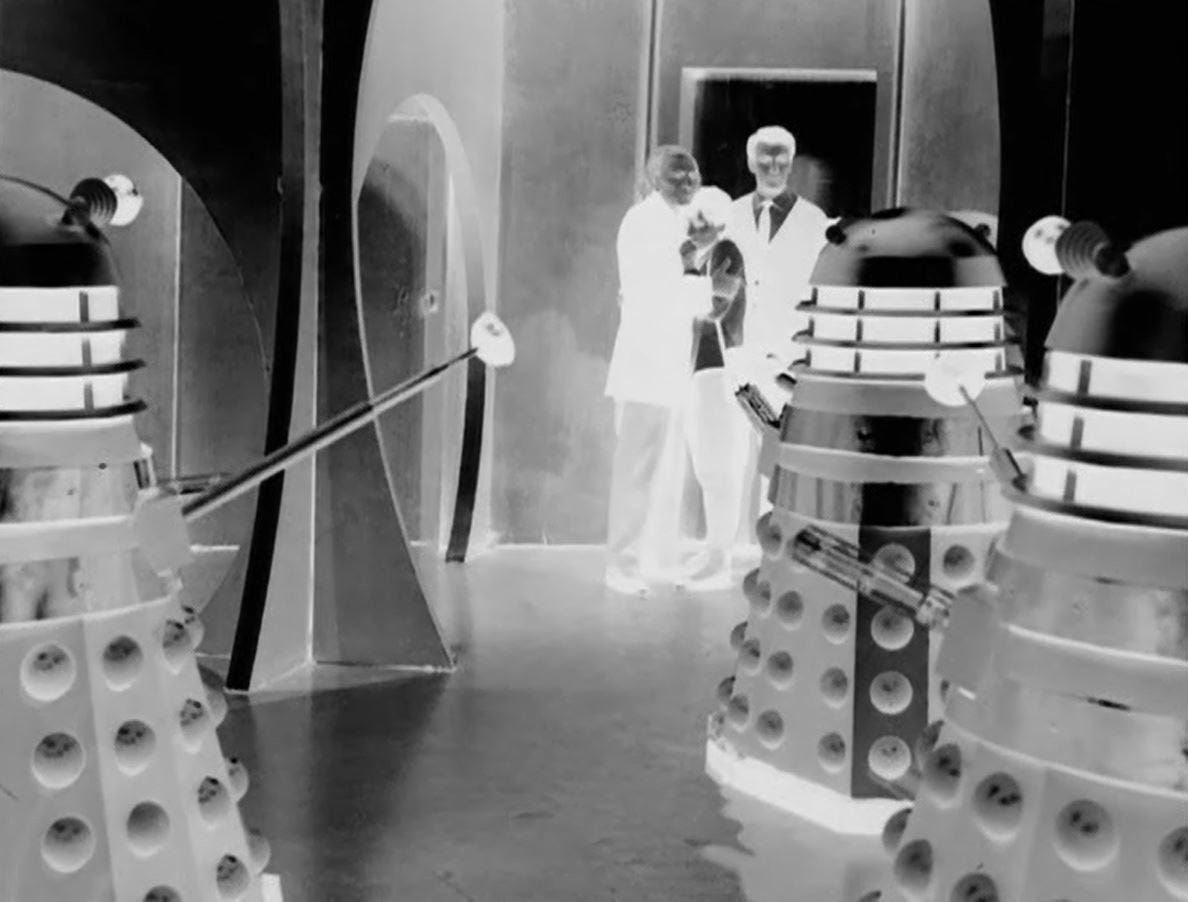
The direction and special effects of early Doctor Who are fascinating and under-explored subjects. When discussing the direction of The Daleks in my Black Archive monograph about the story (out next month – pre-order it here), I concentrated on how the Daleks themselves were presented, for want of space to discuss the serial’s direction more widely. It’s a big topic and one I could not do justice without compromising the text elsewhere. I had particularly wanted to look at the decision to use a negative picture effect to represent the blast of the Daleks’ guns, but it just wouldn’t fit. Here, then, are my thoughts on that subject.
Given the rudimentary technology available, depicting the effect of an alien weapon visually was always going to be a struggle for Doctor Who in its earliest years. It would have been difficult to show a beam, but not impossible. This could be done through time-consuming post-production optical effects on film, as seen briefly in The Moonbase four years later. But the vast bulk of each episode was made in an electronic studio, on videotape, in a small number of lengthy takes, so this was not a practical option.
A superimposition effect could have been applied ‘live’ in studio but this would have been fraught with difficulties. Making a superimposed beam align with the gun and the target during an ‘as live’ studio recording would have been almost impossible, forcing expensive retakes or (more likely) an effect that just didn’t really work. Such misaligned beams (or rays or wibbly wobbly things – whatever) can be seen in The Moonbase and The Tomb of the Cybermen, and they were recorded with a little more flexibility in the studio than was available in the series’ earliest days. The negative effect was a good solution. It required no exactness, effecting the whole picture rather than targeting any one element of it, and was easy to apply.
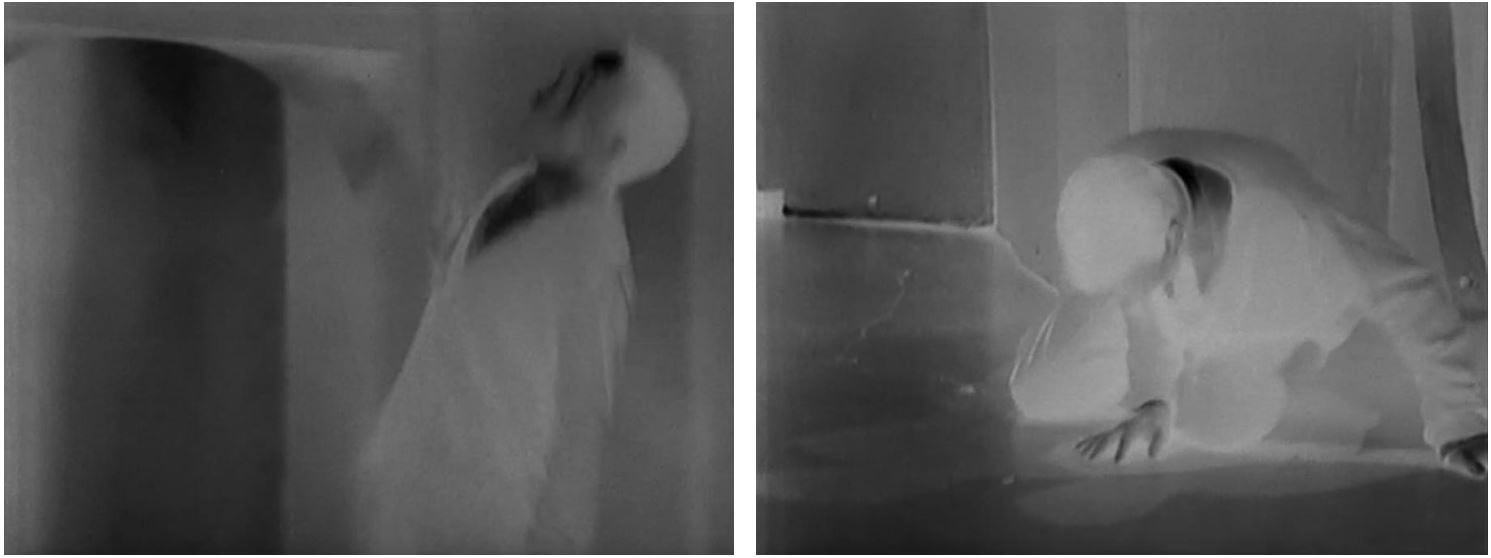
Many accounts of how the negative effect was achieved refer to the cameras having to over-expose the image, with the effect essentially being a picture defect caused by an excess of light. This is not quite accurate. Although over-exposure did cause a negative image (see, for example, how naked flames in early Doctor Who sometimes appear to turn negative as a result of the intensity of light they give out), the Dalek gun effect was not achieved this way. The vision mixing desk in the studio control room, through which all the camera feeds were passed, contained a switch that could turn any given camera feed negative. Clive Doig, who vision-mixed The Daleks amongst many other early stories, recalled that this is how the effect was achieved.
It isn’t clear whether the effect was decided upon by Christopher Barry, who directed the episode in which it was first used, or whether it was suggested by Terry Nation, the story’s writer. The effect is specified in the surviving rehearsal script for that episode (the second), and this is likely an only slightly (if at all) modified version of Nation’s second draft script. This would support it being Nation’s idea. We can’t rule out Barry having added it while planning his rehearsals but, as a technical detail, it would more usually be added by a director at the point of creating their final camera script. I favour it being Nation’s suggestion.
Nation already had a number of television credits by this time so probably had a pretty good idea of what the available technology could (or more pertinently, could not) achieve. He may have been inspired by the use of a negative effect in one of his ITV science fiction productions the previous year. Impostor, which Nation dramatised from the Philip K Dick short story, ends with a colossal explosion. The play is now lost but a set of John Cura’s tele-snaps provides a visual record for how it was realised by director Peter Hammond. These appear to show the last few shots, as the bomb explodes, being in negative (although it could also be a posterisation effect; it’s hard to tell from the tiny telesnap images).
This wasn’t the first time a negative effect was deliberate employed in television drama. Frankly, the history of early television drama is so lacking in visual evidence that we can’t be sure when it was first used. First used deliberately, I mean – an example of parts of the image accidentally flipping into negative can be seen in the second episode of The Quatermass Experiment from 1953, thanks to the crude technology then in use.
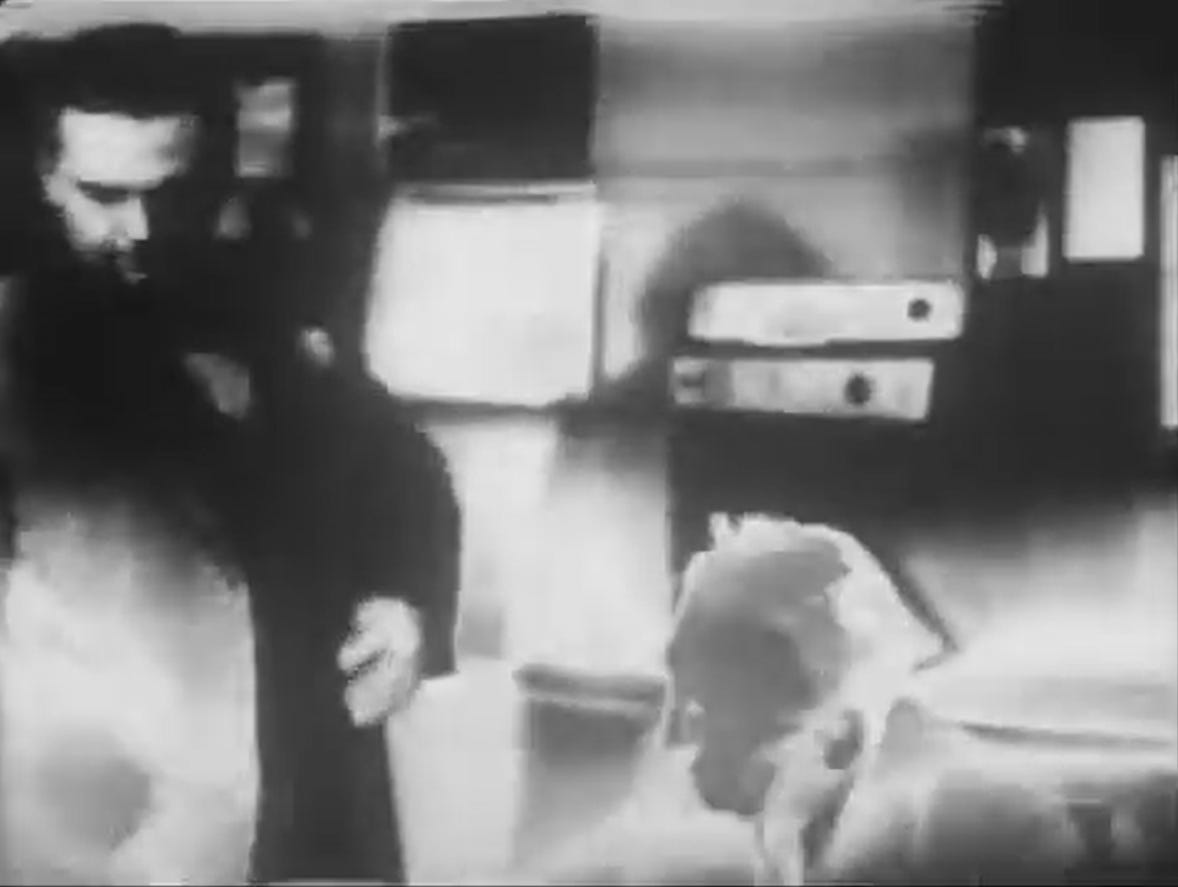
An early deliberate use of the effect occurred in the television play L’Aiglon, also from 1953 and, coincidentally, also produced/directed by Rudolph Cartier as The Quatermass Experiment was[1]. L’Aiglon was an historical drama about Napoleon II. This live production was never recorded from transmission so is long lost, but Cartier recalled in a 1991 interview using the negative effect to show “white ghostly figures” of the dying at the battle of Wagram “against [a] black background”. A contemporary review in The Daily Telegraph confirms the “ghostly appearance of the dead at Wagram”, albeit finding against its effectiveness.
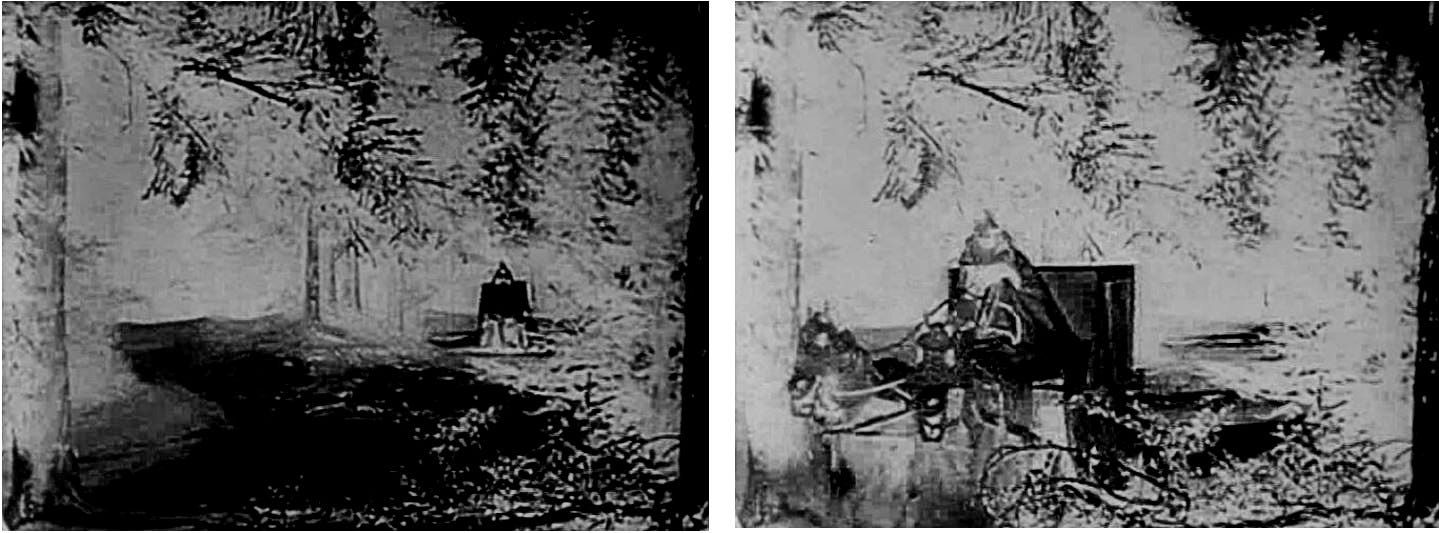
Cartier may have been inspired to use the negative effect by the German expressionist horror film Nosferatu, from 1922, where it was used to give an impression of the uncanny and otherworldly. Noting that Cartier started his career in the German film industry in 1929, he would surely have been familiar with it. From these examples, we can see that a negative image already had some televisual and filmic associations with violence and the fantastical long before it was used in Doctor Who. No doubt there are other earlier examples I am not familiar with (the internet isn’t helpful here given the generic search terminology). Please do leave comments to tell me of any.
The effect continued to be associated with extreme violence. A negative effect was used by Peter Watkins in his controversial drama documentary The War Game – filmed by the BBC for transmission in 1965 but banned until 1985 – to represent the sudden heat and blast of a nuclear explosion.
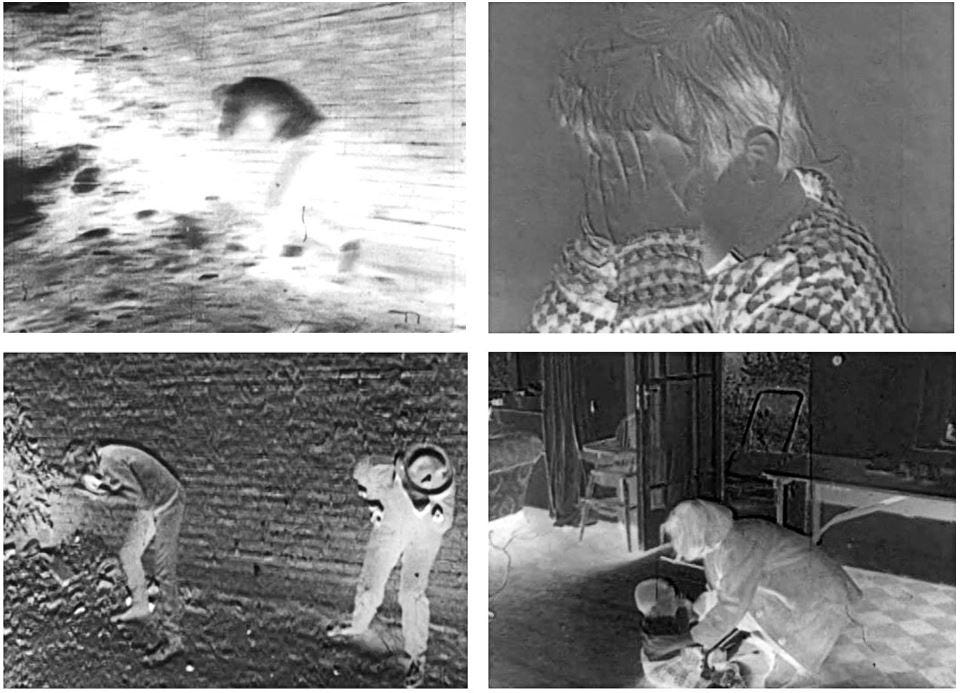
Given its use in The Daleks, a story about the results of nuclear war, it appears as if a thematic association of great heat and/or nuclear energy was becoming attached to the effect. It’s been suggested at least once that the climactic unleashing of the nuclear source in the 1955 film Kiss Me Deadly (sorry, that was a spoiler, but it’s been 71 years…) also results in a negative image effect. In fact, it doesn’t. The effect was achieved simply with extremely bright white light, but it seems that the same associations were in play. Bright white light denotes the extreme dangers of nuclear or unknowably alien power, and broadly the negative effect does the same.
The use of the negative effect in Doctor Who was a pragmatic choice, yet a good one. Indeed, it continued with only minor modifications throughout most of twentieth-century Doctor Who. It shows the impact of the Daleks’ weapons and implies great power or heat (a Thal wounded by a Dalek has burns). It also creates a visual strangeness that suits an alien weapon and, crucially, was easy to achieve live in the studio. Sometimes the simplest effects are the best.
Images © BBC except for those of Nosferatu, which are out of copyright
Thanks to the BFI Special Collections team, Peter Crocker and Anthony Malone
No AI tools were used in the composition of this text
Sources
Review of L’Aiglon by ‘R. P. M. G.’, Daily Telegraph, 13 April 1953
Rudolph Cartier interview, The British Entertainment History Project, 1991 – available here
‘Who Talk’ commentary for The Daleks from Fantom Publishing – available here
[1] L’Aiglon came before The Quatermass Experiment in 1953, in case anyone was thinking the accidental negative effect in the latter could have influenced Cartier to use it deliberately in L’Aiglon.